
🦊 Two projects on creative questions
Gathering people and being a regular

For someone who’s moved around cities and countries a few times in life, I actually like routines quite a lot. It’s been many months now since I started going to the gym where I practice Muay Thai, and I’ve begun to recognize many of the people who are there regularly. I wouldn’t call them friends, but they’re people I nod to when I arrive, or who notice my presence when they walk in.
I spend so much of my life invisible, tucked away inside my home, that these small moments of recognition feel like a nest I can rest in.
Three times this week I went to train Muay Thai, and all three times I didn’t want to go. I went anyway, “out of sheer spite” as I like to say, because I recognize the transformation the practice has been bringing me. On Friday, as I was leaving the gym, the guy at the front desk said he admires how much I’ve changed.
“At the beginning,” he said, “you were more delicate, more hesitant to fight. Now you go for it, you hit, you get hit, and you go at it with grit.”
I was happy to hear that, because it points toward something I want to become. I want to live without fear, and I believe Muay Thai can teach me to face it head-on. If not all fears, then at least the fear of taking a punch to the face or a kick to the gut.
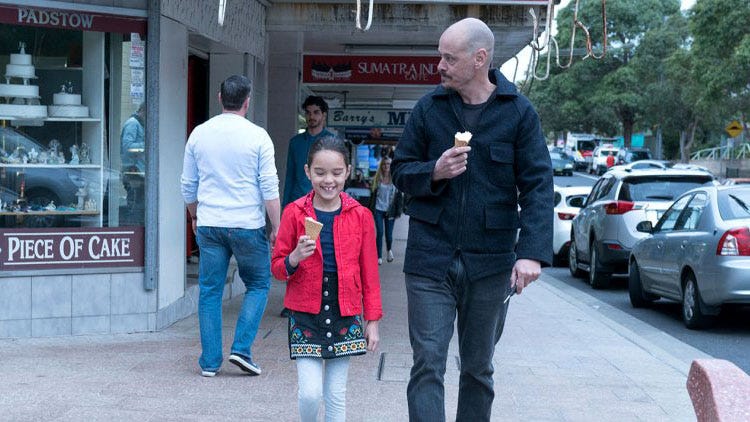
I’ve been watching the series Mr Inbetween, about an Australian criminal who kills and extorts people for money while also caring for his sick brother, raising a young daughter (now a teenager in the third season), and maintaining a personal code of ethics centered on respect.
At one point in the show, Ray, the main character, is talking to a man about violence not being a good answer to life’s challenges.
“Maybe I’m just a pacifist,” the man says.
“No, you’re scared,” Ray replies.
That brief exchange reminded me of an idea I once read somewhere: that you can only truly choose nonviolence if you are capable of choosing violence. I’m not sure I agree with it, but I find myself thinking more and more about the limits of nonviolence as an ideology capable of transforming the world, and I no longer believe that appealing to the empathy of those in power is an effective way to make the world better.
In March, I organized a reflective journey for writers entirely through WhatsApp, where I shared 20 questions, one per day, about the role of writing in each person’s life. Some examples included:
At what point in your life did you realize you wanted to write? (day 4)
What do you avoid writing about? (day 9)
Is there something you love to read but would never write? (day 16)
It was a pleasure to witness bits and pieces from each participant as new questions were introduced. More than simply reflecting on the questions, reading other people’s responses helped me discover perspectives different from my own.
Between February and March, I decided to set up a creative dilemmas group following instructions shared here. To explain the format, here’s part of the message I sent to each invited person:
Eight creative people in a WhatsApp group;
Once a week, on Saturday, one person (order chosen at random) sends a voice message of up to 5 minutes with a question or dilemma they’re dealing with in life – preferably related to their artistic process, but life is complex and we welcome whatever feels most present;
By the end of Sunday, the other seven people respond in the group with voice messages of up to 10 minutes;
No one is obligated to listen or comment if they don’t want to or don’t have the time, and the group doesn’t need to debate or develop a conversation from the question – it’s one audio asking for support, seven audios offering perspectives; you listen if you want;
After eight weeks, once everyone has asked one question, we hold a reflection round, say goodbye, and close the group;
Since this is an experimental format, I don’t know what to expect. The only thing I ask of those I invite is that they commit to participating across those eight weekends – 15 minutes total, 5 to ask/listen to a question and 10 to respond.
This weekend, we concluded the process. Many of my impressions were similar to those of the person who originally shared the format (I recommend checking out the original text), but I’d like to highlight a few personal reflections:
Once again, I was amazed by the creative power that emerges when someone extends an invitation and holds a time-space for humans to meet and spend time together. I gathered seven friends, many of whom didn’t know each other, and watched small pieces of their worlds connect through the questions that were shared.
Everyone I invited participated by bringing their own questions to the group, though not everyone responded to every question. At first, I felt a bit frustrated, as I had expected everyone to fully uphold the commitment, but once I relaxed the experience became more enjoyable.
I found the time between question and responses quite appropriate, but the gap between each round made me feel somewhat disconnected from the process. I’ve been wondering whether a cycle every 2–3 days, instead of once per weekend, might create a stronger sense of connection – although it might also make it harder for people to sustain participation.
I usually facilitate group processes more than I actually participate in them. Here, once the instructions were set, I was just another participant, and I really enjoyed that perspective.
In the WhatsApp group for writers, the dynamic mostly unfolded between my questions and the individual responses shared with the group, with occasional exchanges between participants. In this creative dilemmas project, on the other hand, every message was aimed toward direct exchange with others in the group. That’s a dynamic I want to replicate more often in the future.
Eight people felt like a good size. I think the group might have felt more alive with more participants, but also harder to fully follow. With one question and up to seven responses each weekend, I was able to listen to everything everyone shared. That’s a level of commitment I probably wouldn’t sustain with a larger group.
A big thank you to Bryan Kam , who shared this format in their newsletter.
With love,
Tales
I'm thrilled you tried it and that it was a good experience!